Tracing in OpenGGCM fields#
[1]:
from __future__ import annotations

import numpy as np
import pyvista as pv
import xarray as xr
from scipy import constants

import ggcmpy.tracing


def to_mesh_lines(df):
    positions = df[["x", "y", "z"]].to_numpy()
    mesh = pv.PolyData(positions)
    lines = pv.lines_from_points(positions)
    return mesh, lines


def plot_trajectory(plotter, df, **kwargs):
    _, lines = to_mesh_lines(df)
    plotter.add_mesh(lines, **kwargs)
Load an actual OpenGGCM dataset#
It’s not from an actually meaningful simulation, but it’ll do for now. The code below loads the data (which was generated with etajout=true), and then rescales to base SI units (FIXME: we should have the option to just trace in the original units).
In addition, it sets the electric field to zero to make things simpler.
[2]:
R_E = 6.371e6  # m

ds = xr.open_dataset(ggcmpy.sample_dir / "test0008.3df.000007")
x, y, z = R_E * ds.x.values, R_E * ds.y.values, R_E * ds.z.values
ds = ds.assign_coords(
    x=("x", x),
    y=("y", y),
    z=("z", z),
    x_nc=("x_nc", 0.5 * (x[1:] + x[:-1])),
    y_nc=("y_nc", 0.5 * (y[1:] + y[:-1])),
    z_nc=("z_nc", 0.5 * (z[1:] + z[:-1])),
)
ds["bx1"] = (("x_nc", "y", "z"), 1e-9 * ds.bx1.values[:-1, :, :])
ds["by1"] = (("x", "y_nc", "z"), 1e-9 * ds.by1.values[:, :-1, :])
ds["bz1"] = (("x", "y", "z_nc"), 1e-9 * ds.bz1.values[:, :, :-1])
ds["ex1"] = (("x", "y_nc", "z_nc"), 0 * ds.eflx.values[:, :-1, :-1])
ds["ey1"] = (("x_nc", "y", "z_nc"), 0 * ds.efly.values[:-1, :, :-1])
ds["ez1"] = (("x_nc", "y_nc", "z"), 0 * ds.eflz.values[:-1, :-1, :])
ds
[2]:
<xarray.Dataset> Size: 48MB
Dimensions:       (x: 128, y: 64, z: 64, x_nc: 127, y_nc: 63, z_nc: 63, time: 1)
Coordinates:
  * time          (time) datetime64[ns] 8B 1967-01-01T00:00:07.130000
  * x             (x) float32 512B -1.911e+08 -1.792e+08 ... 1.808e+09 1.911e+09
  * y             (y) float32 256B -3.186e+08 -2.892e+08 ... 2.892e+08 3.186e+08
  * z             (z) float32 256B -3.186e+08 -2.892e+08 ... 2.892e+08 3.186e+08
  * x_nc          (x_nc) float32 508B -1.851e+08 -1.735e+08 ... 1.86e+09
  * y_nc          (y_nc) float32 252B -3.039e+08 -2.755e+08 ... 3.039e+08
  * z_nc          (z_nc) float32 252B -3.039e+08 -2.755e+08 ... 3.039e+08
Data variables: (12/25)
    bx            (x, y, z) float32 2MB ...
    by            (x, y, z) float32 2MB ...
    bz            (x, y, z) float32 2MB ...
    vx            (x, y, z) float32 2MB ...
    vy            (x, y, z) float32 2MB ...
    vz            (x, y, z) float32 2MB ...
    ...            ...
    xtra2         (x, y, z) float32 2MB ...
    inttime       (time) int64 8B ...
    elapsed_time  (time) float64 8B ...
    ex1           (x, y_nc, z_nc) float32 2MB 0.0 0.0 0.0 0.0 ... -0.0 -0.0 -0.0
    ey1           (x_nc, y, z_nc) float32 2MB 0.0 0.0 0.0 0.0 ... 0.0 0.0 0.0
    ez1           (x_nc, y_nc, z) float32 2MB 0.0 0.0 0.0 0.0 ... -0.0 -0.0 -0.0
Attributes:
run: test0008Trace using the Boris integrator#
That’s pretty much just the same as in the dipole example, but using the OpenGGCM fields.
[3]:
boris = ggcmpy.tracing.BorisIntegrator_f2py(ds, q=-constants.e, m=constants.m_e)
x0 = np.array([-5.0 * R_E, 0, 0])

B_x0 = boris._interpolator.B(x0)
T_e = 1.0 * 1e3 * constants.e  # 1 keV in J
v_e = np.sqrt(2 * T_e / constants.m_e)  # electron thermal speed
v_e *= 100.0

om_ce = np.abs(constants.e) * np.linalg.norm(B_x0) / constants.m_e  # gyrofrequency
r_ce = constants.m_e * v_e / (constants.e * np.linalg.norm(B_x0))  # gyroradius
print(f"B={B_x0} om_ce={om_ce} r_ce={r_ce}")  # noqa: T201

v0 = np.array([0.0, v_e, v_e])  # [m/s]
dt = 2 * np.pi / om_ce / 20
t_max = 500 * 2 * np.pi / om_ce  # [s]

df = boris.integrate(x0, v0, t_max, dt)
df
B=[0.00000000e+00 1.99064813e-16 2.47747835e-07] om_ce=43574.3848688326 r_ce=43042.197072298615
[3]:
| time | x | y | z | vx | vy | vz | |
|---|---|---|---|---|---|---|---|
| 0 | 0.000000 | -31855000.0 | 0.000000 | 0.000000e+00 | 0.000000e+00 | 1.875537e+09 | 1.875537e+09 |
| 1 | 0.000007 | -31857072.0 | 13195.142578 | 1.352346e+04 | -5.749702e+08 | 1.784837e+09 | 1.875912e+09 |
| 2 | 0.000014 | -31863088.0 | 25114.351562 | 2.705193e+04 | -1.094160e+09 | 1.521589e+09 | 1.876929e+09 |
| 3 | 0.000022 | -31872466.0 | 34606.066406 | 4.058892e+04 | -1.507335e+09 | 1.111443e+09 | 1.878275e+09 |
| 4 | 0.000029 | -31884298.0 | 40754.703125 | 5.413516e+04 | -1.774739e+09 | 5.942084e+08 | 1.879494e+09 |
| ... | ... | ... | ... | ... | ... | ... | ... |
| 9997 | 0.072074 | -25325260.0 | -433478.218750 | -1.013405e+07 | 8.069608e+08 | 1.252936e+09 | 2.194149e+09 |
| 9998 | 0.072081 | -25321328.0 | -420595.406250 | -1.012162e+07 | 2.842814e+08 | 2.320795e+09 | 1.252365e+09 |
| 9999 | 0.072089 | -25321826.0 | -402791.875000 | -1.011731e+07 | -4.223673e+08 | 2.617960e+09 | -5.669133e+07 |
| 10000 | 0.072096 | -25327236.0 | -385979.031250 | -1.012220e+07 | -1.078690e+09 | 2.045977e+09 | -1.298356e+09 |
| 10001 | 0.072103 | -25336414.0 | -375734.250000 | -1.013431e+07 | -1.467493e+09 | 7.959528e+08 | -2.061127e+09 |
10002 rows × 7 columns
[4]:
import pandas as pd
import scipy.integrate


def trace_field_line(r0, get_B, r_min=0.5, r_max=10.0):
    """Trace a magnetic field line starting at position r0 in the field
    provided by the get_B function.

    This function integrates the field line in the positive direction
    until it get either closer than `r_min` to the origin, or outside of `r_max`.

    Returns a pandas DataFrame with columns 'time', 'x', 'y', 'z'.
    """

    def rhs(t, x):  # noqa: ARG001
        B = get_B(x)
        B /= np.linalg.norm(B)
        return B

    def outside(t, x):  # noqa: ARG001
        return np.linalg.norm(x) - r_max  # stop if r > r_max

    outside.terminal = True
    outside.direction = 1  # only trigger when approaching from inside

    def inside(t, x):  # noqa: ARG001
        return np.linalg.norm(x) - r_min  # stop if r < r_min

    inside.terminal = True
    inside.direction = -1  # only trigger when approaching from outside

    tf = 1e9
    sol = scipy.integrate.solve_ivp(
        rhs, (0.0, tf), r0, events=[outside, inside], max_step=0.1 * R_E
    )
    sol2 = scipy.integrate.solve_ivp(
        rhs, (tf, 0.0), r0, events=[outside, inside], max_step=0.1 * R_E
    )
    dfs = [
        pd.DataFrame(np.column_stack((s.t, s.y.T)), columns=["time", "x", "y", "z"])
        for s in [sol, sol2]
    ]
    return pd.concat((dfs[1].iloc[::-1], dfs[0]), ignore_index=True)


def trace_field_lines(seeds, B_func, integrate_kwargs):
    """Trace multiple field lines.

    This is a convenience wrapper around trace_field_line.
    `seeds` is a list of starting positions.
    `B_func` is the magnetic field function.
    `integrate_kwargs` is a dictionary of additional keyword arguments to pass to
    `trace_field_line`.

    Returns a list of pandas DataFrames, one per seed point."""
    return [trace_field_line(r0, B_func, **integrate_kwargs) for r0 in seeds]


seeds = [
    r * np.array([np.cos(phi), np.sin(phi), 0.0])
    for phi in np.linspace(0.0, 2.0 * np.pi, 16, endpoint=False)
    for r in [3.0 * R_E, 5.0 * R_E]
]

dfs = trace_field_lines(
    seeds,
    boris._interpolator.B,
    integrate_kwargs={"r_min": 2 * R_E, "r_max": 20.0 * R_E},
)
Plot the trajectory#
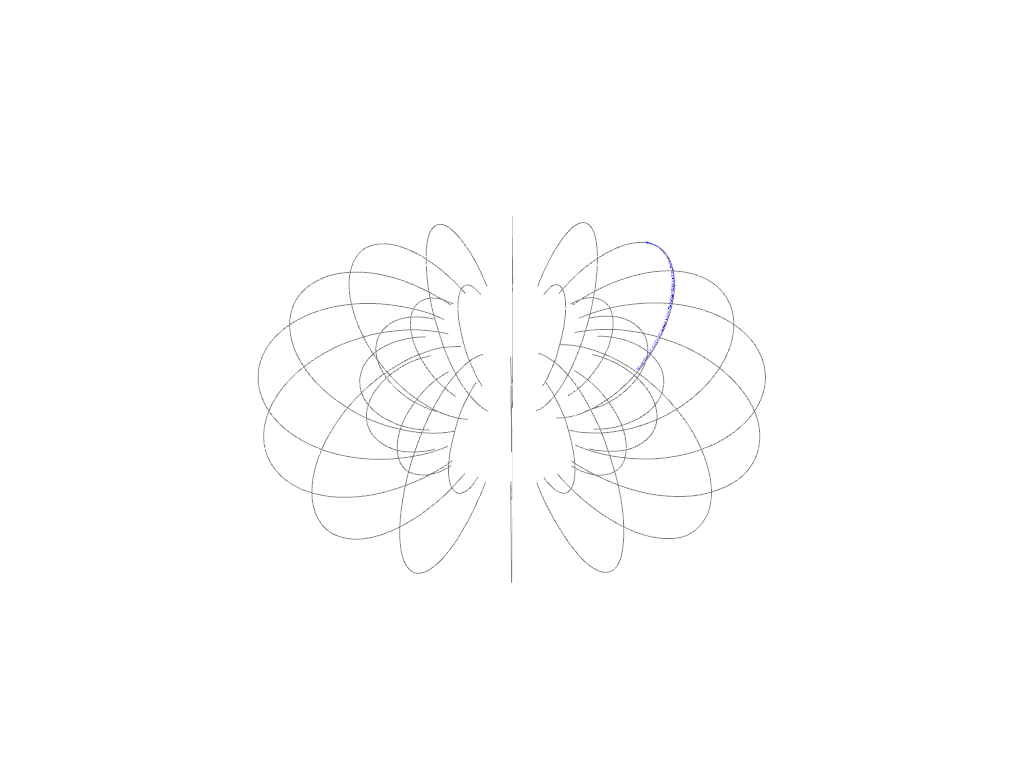
Not all that exciting, but at least it looks reasonable…
[5]:
plotter = pv.Plotter()
plot_trajectory(plotter, df, line_width=1, color="blue")
for _df in dfs:
    plot_trajectory(plotter, _df, line_width=1, color="grey")
plotter.show()
2026-02-18 23:11:08.918 (   2.007s) [    7BC6B6E25B80]vtkXOpenGLRenderWindow.:1460  WARN| bad X server connection. DISPLAY=
/tmp/ipykernel_1748/1878288354.py:5: UserWarning: Failed to use notebook backend:

No module named 'trame'

Falling back to a static output.
  plotter.show()
Check energy conservation#
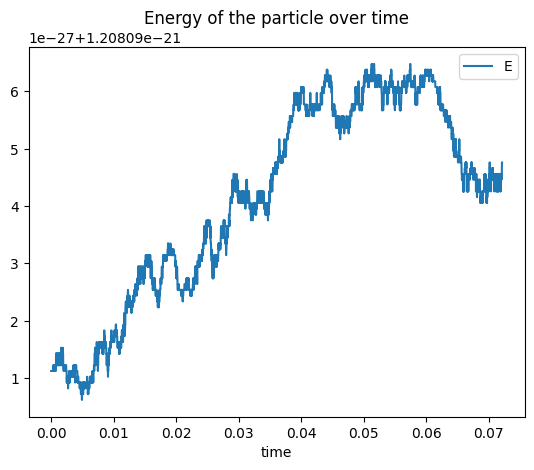
Looks pretty good – the tracing here is done in Fortran with single precision, so a relative error of \(10^{-6}\) is expected due to machine precision.
[6]:
df["E"] = 0.5 * constants.m_e * np.linalg.norm(df[["vx", "vy", "vz"]].values, axis=1)
df.plot(x="time", y="E", title="Energy of the particle over time");